

At the Mpondoland Plug Project, we have always dreamt not only that Mpondoland and its indigenous Cannabis cultivators redeem their rightful place as the primary source of our local Cannabis markets, but that they become the integrated powerhouse and headquarters of the South African Cannabis story across all fields and down all streams of supply.
We’re tired of paying lip service to the original custodians of Cannabis from the comfort of our ivory-towered webinars, events and meeting rooms.
From Mbotyi to Mtambalala, Port St Johns down to Mdumbi, we have dedicated considerable time, effort and resources, on the ground, to consulting directly with farmers about how to build this project with their full cooperation and buy-in. Indeed, as our favourite Cannabis community quote goes: “Nothing for us, without us”.
Eventually, we knew: the time for talking had ended.
We have been driven by adamancy; to start and get something done – start making some sort of tangible difference in the lives of rural AmaPondo Cannabis growers; somehow plugging them into the local market in the here and now.
But, being completely real, if —
- trading in Cannabis beyond the largely unrealistic and elitist reality of licensing regimes remains strictly prohibited, and
- THC in super high doses, almost to the exclusion of the rest of the Plant’s magical goodies, drives the adult-use markets across the ‘legal’ divides,
the question became: How the fuck do we actually stop talking kak and actually do something that matters in the here and now?!
Enter: the initial Pilot of the Mpondoland Plug Project (MPP).
It’s based in the rural coastal village of Mngcibe, where Marleen lives. Close to the Mthatha river that acts as the southern boundary of Mpondoland, Mngcibe lies, next to the Mdumbi river. Its rolling green hills and peaceful valleys are only accessible by dirt road, approximately 1hr15mins from the nearest town, Ngqeleni – highlighting the accessibility and logistical struggles we’ll need to overcome. A tight-knit community, Mngcibe has Cannabis farmers ranging from 16 to 80 years old who grow mainly from cuttings supplied by local entrepreneurs and some of the farmers themselves.
The correct protocol to be followed is to approach the headman or chief of the village and explain the Project to them – this way we ensure cooperation from and due deference towards the village’s structure and this also informs the leadership in advance of our activities, to enable them to help us resolve any internal politics that may arise.
The Pilot started by plugging 8-10 craft AmaPondo Cannabis farmers in Mngcibe into the non-commercial, non-profit, closed-loop ecosystems of Private Cannabis Collectives (PCCs) in South Africa’s major cities that operate under the Shared/Collective Model (SCM) that Harambe Solutions developed.
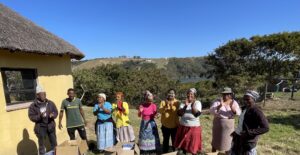
Under this model, each farmer becomes an active cultivating-member of a participant PCC. The plants they nurture form a designated component of the overall private, non-commercial, closed-loop ecosystem jointly owned by the active, participating members of the relevant PCC. Everything grown remains within a closed circle of collective ownership, withdrawn from time to time by members at the urban PCC premises in the metros.
Given that Harambe Solutions is powering the Mpondoland Plug Project, it made sense to get moving in terms of metrics and an operational model that it formulated, offers, and thus intimately understands. Not as a legal solution – we all know that adult-use Cannabis trade is illegal and that there is no legal provision that recognises or regulates a PCC. But rather as a bona fide attempt to directly and responsibly exercise our fundamental (and fundamentally decriminalised) Cannabis Private-Use Rights in private, free and non-commercial community.
In other words, as an exercise in risk mitigation (because haven’t these farmers suffered enough already!?): a genuinely entertainable defense to a charge of dealing in Cannabis. Check out this blogpost about our Shared/Collective Model.
We’ve chosen to power our Pilot through the SCM, assuming the risks that come with it, for the immediate benefit of the participating Pilot farmers and their families in Mngcibe. We do so not as gatekeepers but, in the face of the present regulatory paralysis, as aspirant and adamant bridge-builders to make something happen right now.
Starting our work with this small Pilot in this one village is teaching us the lessons we still need to learn – that we will always be in a state of learning. It gives us an opportunity to recognise and understand our challenges and find ways to overcome them, how to upskill farmers – and how to scale this initiative, from the ground up, before opening up to PCCs that operate in terms of other operational models.
This is only the beginning. As the broader industry matures and the law finally catches up, the Mpondoland Plug Project will expand beyond the non-commercial model — always keeping faith with the heritage, health and, ideally, one day soon, the vitality of the landraces that made South African Cannabis what it is.